
■ Strike of once-in-a-century super typhoon
Saturday September 7 2024, Typhoon No.11 (international name: Yagi) struck northern Vietnam, including Hanoi. It was classified as a “super typhoon” the strongest level in the U.S. Marine Joint Typhoon Warning Center, with maximum wind speeds of 67 m/s (240 km/h) and central pressure of 915 hPa . Typhoon Yagi caused unprecedented disasters throughout Southeast Asia, resulting in the loss of more than 300 precious lives and economic losses of over 400 billion yen in Vietnam, and recorded as once-in-a-century tragic typhoon.
Heavy winds blew down the trees and flood damaged across central Hanoi city and threatened the lives of citizens. Landslides caused serious damage in the northern mountainous areas of Vietnam and a wide range of industries including agriculture, manufacturing and logistics were severely damaged especially in Lao Cai Province, which particularly has vast mountainous area. It was inevitable for the hydropower station, located in the province, owned and operated by us to avoid the disaster.
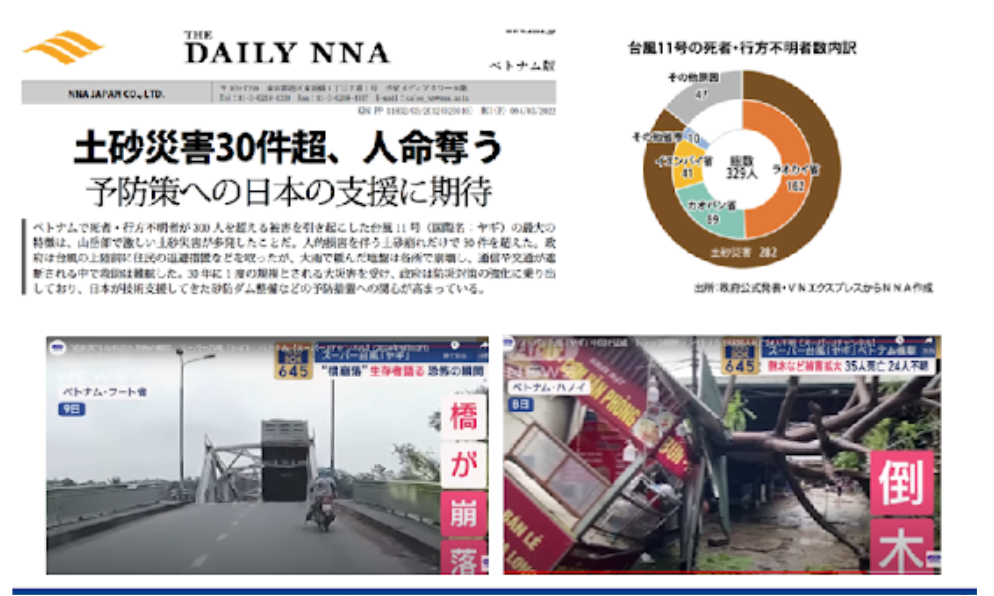
Caption: News report of Typhoon Yagi
■ Record floods, landslides and isolation
On Sunday, September 8, Typhoon Yagi hit the Noi Phat hydropower station. As a result of torrential rainfall equivalent to 25% of the annual rainfall, a record flood of up to 1,900 m3 per second (equivalent to the volume of four swimming pools at elementary and junior high schools in Japan) flowed into the dam. The dam had stopped water intake for power generation prior to flood approach to ensure the safety of the facilities by utilizing dam operation optimization system newly introduced and installed after our investment in the project, however, the unprecedented tremendous amount of inflow caused the dam to start emergency discharge. At the power plant located downstream of the dam, muddy water containing sediment overflowed 8m high concrete wall and flowed into the power plant’s water discharge yard. Fortunately, there were no human casualties or damage to the facilities due to annual disaster countermeasure training and advance preparations for the attack of Typhoon Yagi.
On the following day, Monday September 9, while heavy rain continued to pour and flooding response was still ongoing, landslides occurred at three different locations near the power plant and mudslides covered near the power plant. An emergency recovery support team, including the top management of the project company were dispatched from Hanoi to the site, but part of the access route to the power plant collapsed and forced the team to detour, which caused additional time to access the site. Furthermore, a landslide in the province caused the collapse of communications tower covering the surrounding area and communications with the site were interrupted. The power station was isolated under extreme circumstances.
While praying for the safety and security of all power station employees, national staff and I worked closely with the power station as well as our head office to grasp the latest situation of the power station, and plan, discuss, and support the execution of recovery measures. We thought everyday about what we should do and what we can do and put it into action.
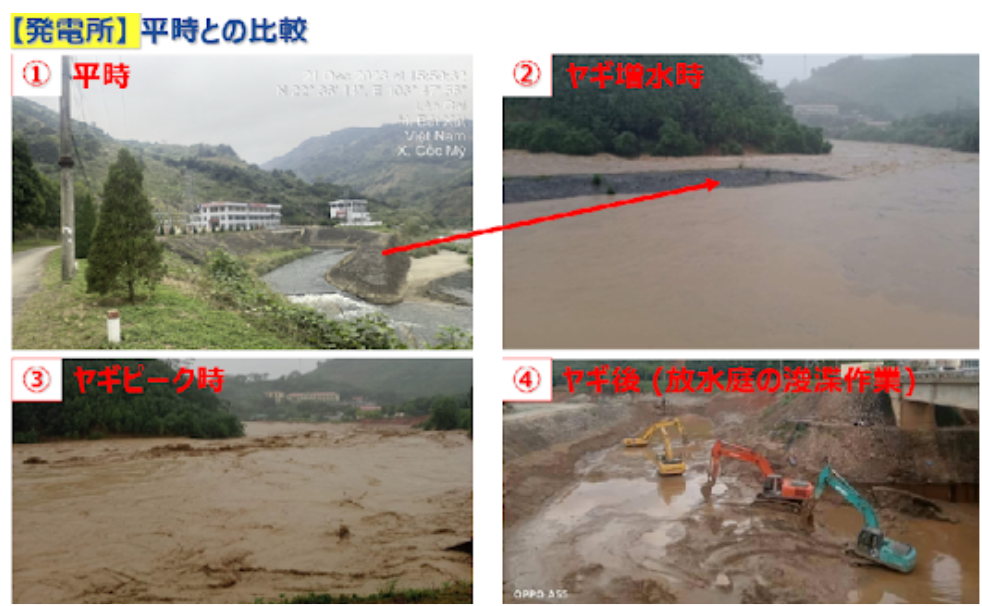
Caption: Power plant before and after Typhoon Yagi
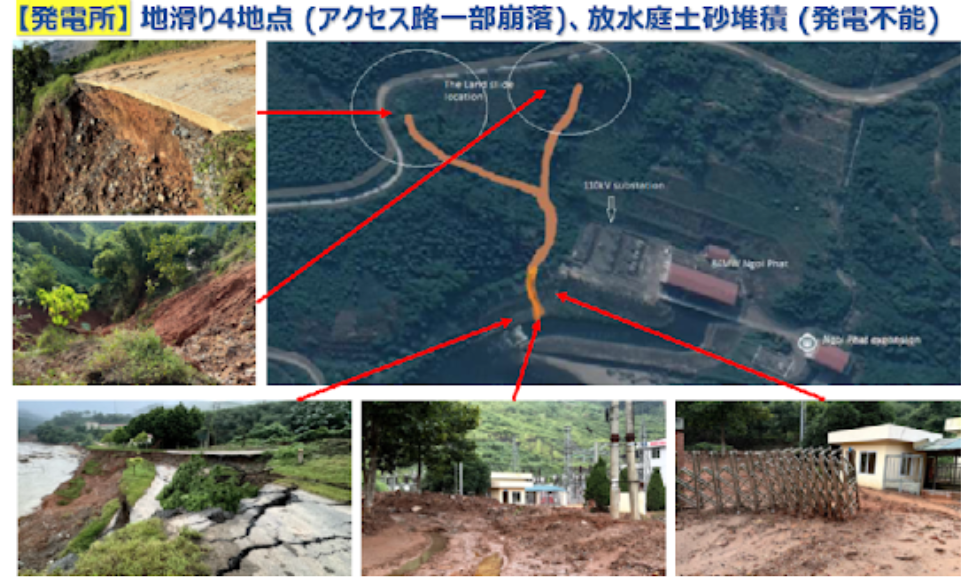
Caption: Landslide near the power plant after Typhoon Yagi
■Recovery support dispatch, DNA questioned
On Tuesday September 10, a new landslide occurred near the power plant while the rain continued to fall. Fortunately, there was no damage to the power plant’s staff or facilities, but the power station could not resume power generation due to some of the facilities being clogged with muddy soil. The power station requested emergency assistance from local authorities and construction companies to supply bulldozers for dredging the muddy soil, however, providing recovery support to the public was the top priority. The power plant was forced to dredge the muddy soil using a bucket brigade method with the five excavators, which after struggle they could secure.
While we were exerting our effort together as a team to restore power supply to the area as soon as possible, two national staff voluntarily offered to be dispatched to the site for on-site 3recovery support. Both national staff are certified electrical engineers with over 20 years of experience in the hydropower generation business, and it was clear that they were well-suited for the assignment. Also, from the course of daily discussion with the project company and shareholding partner management, I was aware of the high expectation for our on-site support from partners. Further, I myself understood well that dispatching those two national staff members were the overall optimal approach. However, site were under the risk of floods and intermittent landslides. Caught between the top priority of ensuring the safety of my subordinates and restoring the power generation at the earliest to deliver power to the area, I suffered in making a decision that could possibly affect the lives of my subordinates and their families. After many discussions with the national staff and upper management about safety measurement and respecting each team member’s strong will, the decision were made to dispatch our emergency recovery support team with safety as top priority. The discussion was also a moment that questioned the meaning of humanity – how we should live as people.
As a result, they arrived safely on the scene the following day, Wednesday September 11 and worked closely together with the project company to restore power generation. Under extreme circumstances without communication network, both exerted best efforts to diagnose the situation accurately on-site and execute countermeasures, deriving best possible restoration plan. Their actions were true symbol of Gembality – the ability to make decisions and take action rooted in the field .
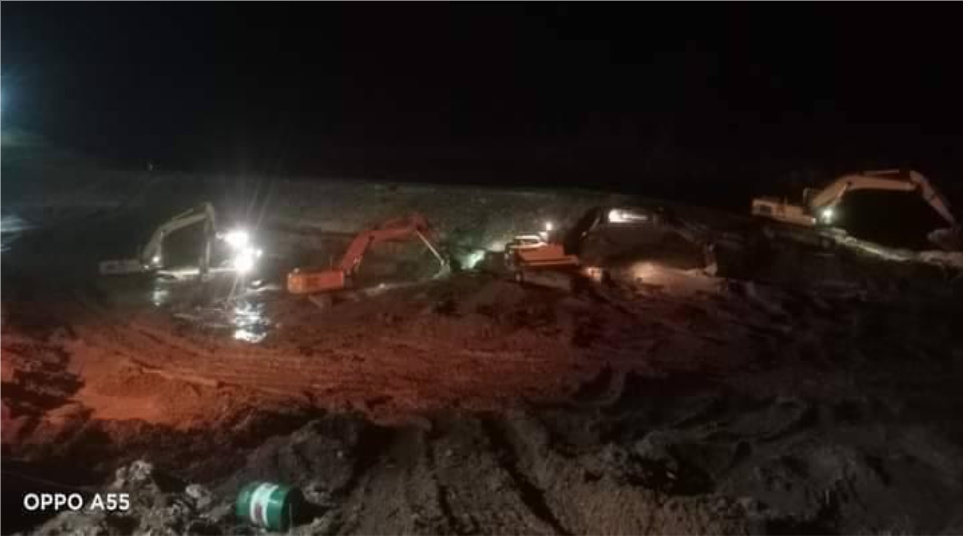
Caption: Dredging work by excavators (bucket brigade method, continued recovery work throughout nights)
■ Beyond—light at the end of the tunnel
As a result of project company and shareholders pulled through this unprecedented historic disaster together, the power plant was able to resume power generation in just 10 days and provided stable power to the local community, supporting the foundation of recovering people’s lives, and underpinned the restoration activities throughout Lao Cai Province. The ordeal of Typhoon Yagi brought many disasters and difficulties, confronted the unavoidable reality of the coexistence of renewable energy power plants with nature to achieve carbon neutrality. However, the story of those involved who overcame these circumstances was more than mere disaster countermeasures. In the midst of adversity, the project company and shareholders supported each other, pooled their wisdom as one and enhanced trust, and took a step forward together towards new Beyond – leading to more resilient future disaster countermeasures.
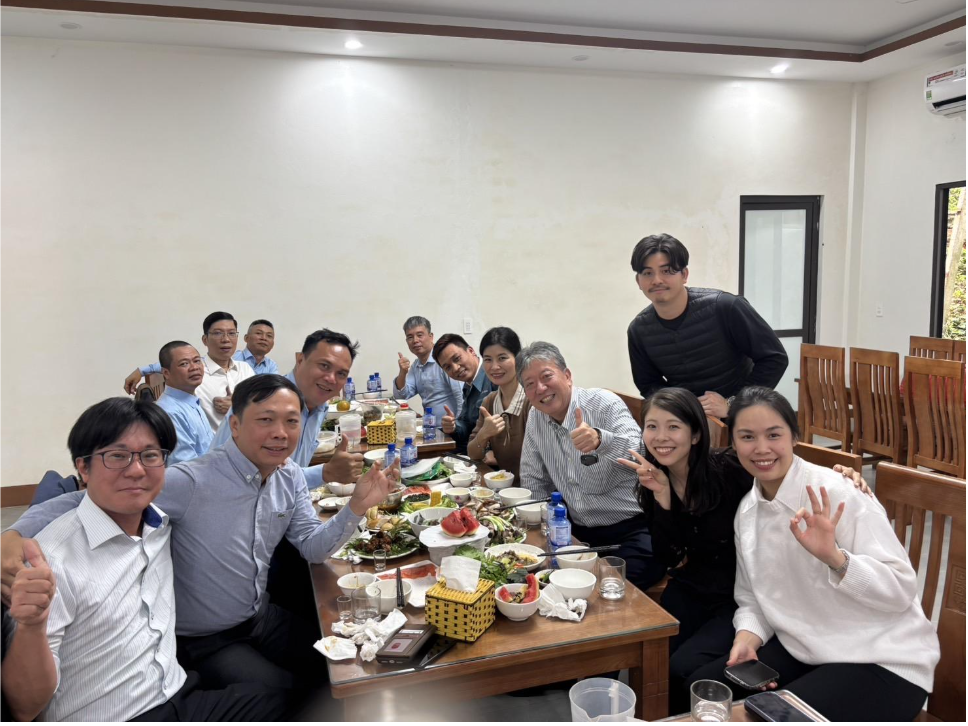
Caption: 2024 Dec. At power station canteen with power station staff (our family) (front row,
third from right: Kunihiro division CEO)
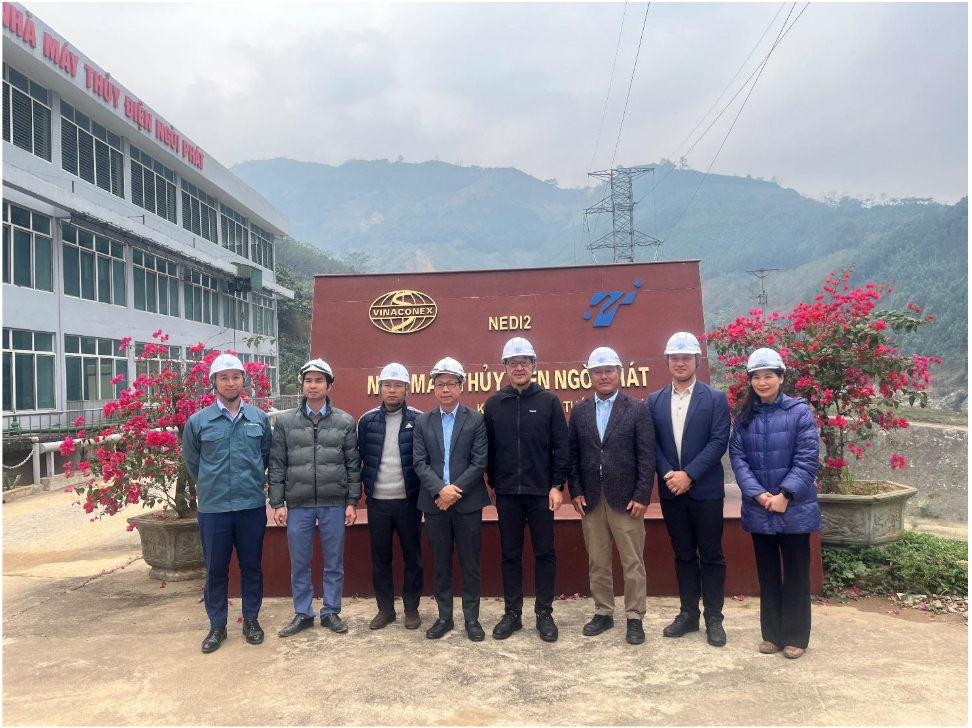
Caption: 2025 Feb. Encourage the reconstruction at the power house (front row from left, author,
Phong Deputy Director, Truong General Manager, Imai Executive Vice President (at the time),
TTVN Miyajima General Director (at the time), Kurata Next Mobility Development Department General Manager
(at the time), Linh secretary)
